My best friend Heather came over to visit me and my husband a few weeks ago. Among other things, we were just catching up on life and reminiscing about days of old. She has a son who’s five now, and so the new stories usually surround him and what he’s been getting in to.
You see, my husband and I do have a dog, but other than that, we don’t have children, and so we fill our time with a variety of interests. One of late has become collecting diamonds and gems—lab-grown diamonds, to be more specific.
In my earlier blog post, I talked about how I was first introduced to Diamond-Tok and lab-grown diamonds via TikTok channels. What I didn’t quite share with you is the reaction that we’ve had from our circle of friends and family. You’ve already heard about the initial reaction that my husband had when I made my first purchase—in a word, he thought I was nuts. Now that he’s come around and we’ve been open to others about the items that we’ve been buying, they’ve started to question our judgment—and perhaps our sanity as well. This is not to say that we have heaps of them, nor could we fill a shop, but when you’ve only had one or two pieces with diamonds or some sort of gemstones anything above that number already feels exciting.
When I first shared with Heather that I bought some diamonds, her reaction was simply, “okay...” She’s used to me trying different things. But as the weeks and months have carried on, and my little collection started to build (as well as my husband’s), she asked me point-blank, “What the hell is going on over there?”
Instantly, I felt like one of those bored retirees that you might picture. You know the type, those empty nesters who are just looking for something to fill the time and pick up a variety of hobbies and fixations that result in coin, doll, or stamp collections. Now, to be fair, that could be us—we’re certainly not getting any younger. However, I also think it’s a little bit more than that.
During her visit, after we caught up on our goings on, Heather got to see our respective collection and her reaction was spot on. “You guys are so extra,” she said.
Gleefully, I said, “Yes, we are!”
You see, I didn’t take that as a dig or any type of criticism. It’s just an observation. Yes, we are doing things a little extra, and perhaps even living life a little extra. Anyone will tell you, I’m always looking for an opportunity for an upgrade, flight, hotel room, doesn’t matter. And yet her words gave me pause and I felt there was something important about what she had landed on, whether she realized it or not. Now, for me, it hit a little different, even beyond that, because it took me back to when I was seeing my therapist.
You see, about five years ago, after about a year into the pandemic, my husband and I experienced a difficult time in our marriage—as I’m sure a lot of couples did. Perhaps it was having periods of spending 24 hours a day together. Perhaps it was not being able to go where and when we pleased. Or maybe it was just all of the sadness and the heaviness that surrounded what was a very difficult time in the world. Whatever the case may be, all of this started to add up. Our communication became more and more challenging, and our arguments were more frequent.
Anthony, my husband, had for years encouraged me to seek therapy. I just hadn’t found what I thought was the right reason to go. Well, eventually I did find reason enough to go, and during that time with my therapist, I learned some important things. I learned that, for one, I was in charge of my own happiness and that this wasn’t something that my husband was responsible to produce for me.
I think in part I realized that, but deep down inside, I did really feel that it was not just up to me—that he had accountability in my happiness. That’s not to say that he didn’t want to do things that I would find pleasing or that could make me happy—he did and continues to. But the overarching, day-to-day activities I chose to partake in (or not), the way that I chose to even look at life to feel or validate joy, was up to me.
Now, these are easy words to say, but how do you start to experience happiness—even your own happiness—if that’s not something that you have consciously worked at? Perhaps for some people it comes naturally but based on the many conversations I’ve had with a variety of friends and acquaintances, that’s not an understood rule. That’s not a common truth.
During therapy, when we did talk about how you build up happiness, my therapist challenged me to come up with some tangible things, but he put it into context first. “As an adult,” he said, “it’s not often that you’re able to just take a victory lap. You do things day in and day out. You face challenging situations, difficult conversations. You work hard. You get the project done. You wind up getting recognized at work, perhaps a promotion. You wind up just being able to pay off your credit card. Yet, you don’t really have an audience of people sitting there clapping for you, cheering you on, and telling you that you’ve done a good job.”
Because I did not take my metaphoric victory laps, what this did for me was raise the expectation each and every time. Where I did a good job or even great work, that became the norm—the expectation. I was happy to beat myself down when I didn’t achieve what I thought I should or what I’d set out to do, but I tell you, when I nailed it, it was just like, “okay, yeah, I knew I could nail it. That’s good.” You see the way I just threw that away? I didn’t bring the importance to it that it really deserved.
The coaching I was provided during my session was, “I need for you to recognize when you’ve done a good job.”
If you’re lucky, your parents do activities and make the acknowledgements when you’re young and growing up. What can happen, even in these situations is that you grow up and it just stops or you’ve become numb to it through expectance. In any case, where does that leave you? And, naturally, I was provided an answer to this: “You should figure out how to reward yourself.” I was so confused. Reward myself for what? The words actually sounded preposterous. “When you’ve done a good job, it should be noted. When you do a great job, you have to acknowledge it. When you do an outstanding job, how could you not celebrate it?”
I chewed the concept over in my mind. “What do I need to say to myself?” We’d done Mirror Work previously, so I parked this idea with having to do with words.
“It’s not just about what you say to yourself,” he continued. Your body needs to learn that it has done something good. It’s not just about what’s going on in your head. It’s the whole person that needs to feel that you’ve accomplished something, and what it’s like to be rewarded for doing a good job.”
I had no clue where to begin, despite really giving it some consideration. Ultimately, he gave me a homework assignment to really come up with some realistic ideas.
The trouble I was having was wrapped up in needs and wants. As you get older, you don’t necessarily need a whole lot. Perhaps you want a few things, but they are typically bigger things that are planned like wanting to pay off a bill, purchase a new car, or go on a trip. How were these things that took longer-term planning going to, in the moment, correlate to what your achievement is.
At our next session, I had to admit that “I really wasn’t able to think of anything.” And just like that, the entirety of that session became about figuring this out.
I could only think of a few basic things, like, “Well, every now and then, I like to have dessert here and there.”
“Okay.”
“I do enjoy going out to dinner.”
“That’s great.”
“Occasionally, I might get some bourbon.”
“That’s good too.”
Suddenly, I was on a roll. “I guess it’s nice to get new clothes or something, but I mean, it’s really just work clothes.”
And then he asked, “Could the clothes be for something else? Maybe more for times when you’re not working?”
“I guess. I mean…” I could see I had a resistance to even thinking about what I would want, because in the back of my mind, I was telling myself I didn’t need it. And because I didn’t need it, I could not avail myself of having it just because I did a good job.
I will say that after that session, I had a list, and that list has continued to grow. The way I attacked it was putting items in certain buckets, allowing me to create some parity between my level of recognition with my accomplishment. For example, I have low-effort, medium-level, and then I had big boys. My lists have everything from a night out on the town, getting myself a new bag or shoes, to weekend getaways, and visits to the spa.
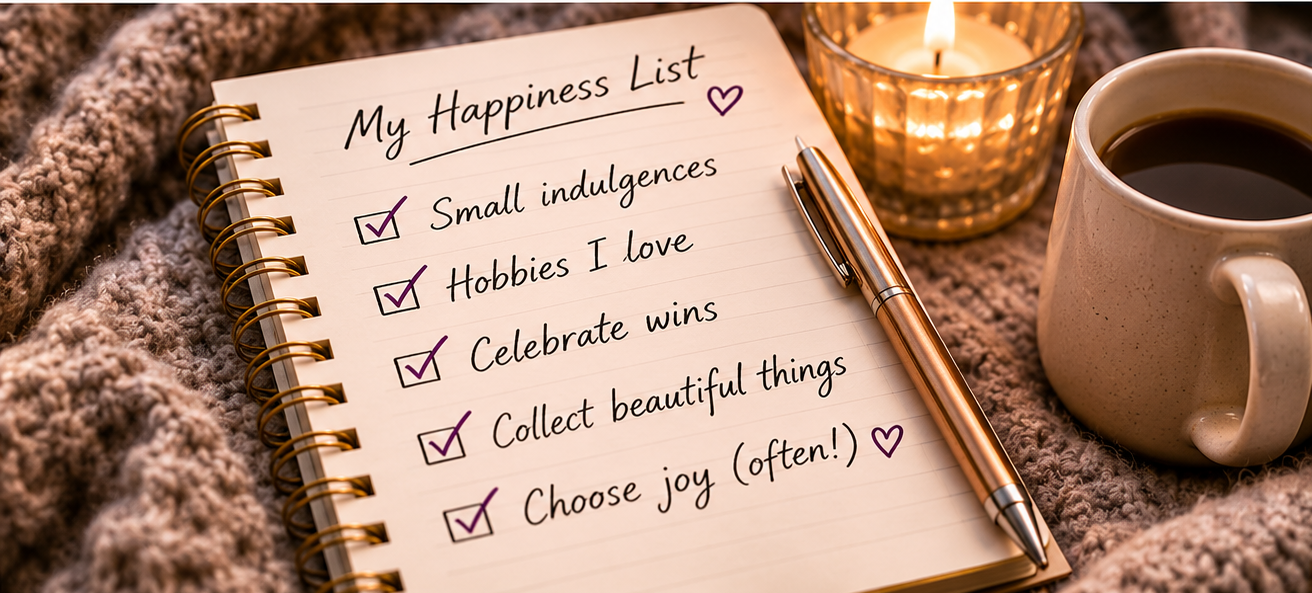
A list to remind myself to prepare for happiness
You see, I needed to have a list of all these things in advance, as my therapist encouraged me to do, “It’s no good if you do the great thing and then spend your celebratory time trying to think of how to reward yourself adequately.” And he’s right. That list needs to be ready for you at all times, so when you do the thing—when you have the tough conversation that had your stomach in knots all night, or when you nail the presentation that you’ve been working hard on—you know exactly what you deserve.”
To this day, after handling tough situations that leave residual feelings, I stop and ask myself, “Marques, what would make you feel better right now?” I pull from my list. I try not to cheat or game the system. You know, I really try to make sure that the reward is in alignment with my performance. And when I do that, I find that I wanna do more of it. I wanna go after more of the tough conversations. I want to do better-quality work. I want to do the hard stuff even more, because I know once I get through it, there is something that I can gift myself right at the end.
So how does this all circle back to somehow having a small collection of sparkly things? I’m at that point in my life now where I’m okay with indulging in the things that might be considered extra to others, because it’s not about the things, it’s about how those rewards make me feel extra nice.
Your happiness can arrive right on time.
Now, all that being said, I do sincerely recognize that we are in a time, particularly in this country where non-essentials can be out of the realm of affordability, possibility, all the things. And there are ways to experience happiness that don’t come at a monetary exchange like a walk along the waterfront, staying home instead of pushing through and going, or allowing yourself a day to binge a show or play video games. There’s always some way that you can let your whole self know that you appreciate what it’s done, and it’s time to focus on you.
For me, I never thought I would have a one-carat this, a two-carat that, in my life. It just wasn’t part of my plan. But somehow, knowing that I can look at my finger and see that I have something on it that helps me recognize what I have accomplished, the life I’ve lived, what I’ve sacrificed, how I have chosen to take care of me gives me renewed joy.
Now, that’s the other piece there: taking care of you when times get really, really tough and you’re at your wits’ end, that when I remember something else that my therapist said to me. It’s the thing that I will carry with me to the day I die, the thing that I have shared with so many others who needed to hear this message—is this:
“Sometimes you have to be the overindulgent parent to yourself—now—that you needed when you were a child.”
So yes, there is an importance to being extra, for me.
I deserve it.
Related-reading: If you’re anything like me and recently discovered the world of Diamond-Tok, be sure to check out my previous post, A Sparkle in the Dark. And even if you’re familiar with this growing trend but don’t have any clue about the importance of cut, clarity, and more, no worries. I’ve put together a guide that is both for novices and even some of the more experienced fans of sparkly things called Diamond-Tok.