A couple of months ago, I had the house to myself. Bailey was at the groomer, Anthony was at an appointment, and I was doing what so many of us do: scrolling TikTok to pass the time.
And then I stumbled into a live auction. People were bidding on loose diamonds. One carat, two, three, more, for prices that stopped me cold.
Up until then, I knew next to nothing about diamonds. I knew carats and shapes. Color, clarity, cut? Clueless. But the prices caught my eye, especially after buying Anthony natural emerald studs that were small and cost about $1200. These were diamonds. They were bigger. And somehow, they cost less.
I was intrigued, and when I’m curious, I tend to follow it, sometimes a little too eagerly.
By the time I put my phone down, I’d bought two round lab-grown diamonds, a five carat and a one carat, for about $600 total.
To put that in perspective, natural diamonds that size would have been a very different purchase. In today’s market, a natural five-carat round typically sells for somewhere around $90,000 to $125,000, and a natural one-carat round averages about $3,500. Together, I’d have been looking at well over $100,000.
When Anthony got home, he thought I’d lost my mind. Honestly, I got it. Who buys diamonds without seeing them in person, let alone on social media?
But when they arrived, they were gorgeous. Truly stunning.
After taking a chance online, I wanted a more traditional approach for the settings, so I went looking for a local jeweler. I found a small shop in Walnut Creek with excellent service. The five carat became a necklace, the one carat, a stud.
The 18K white gold settings were the perfect complement. The price, a little less beautiful: around $2,500 just for settings. It was a crash course. The stone is one cost; craft, design, and metal are another.
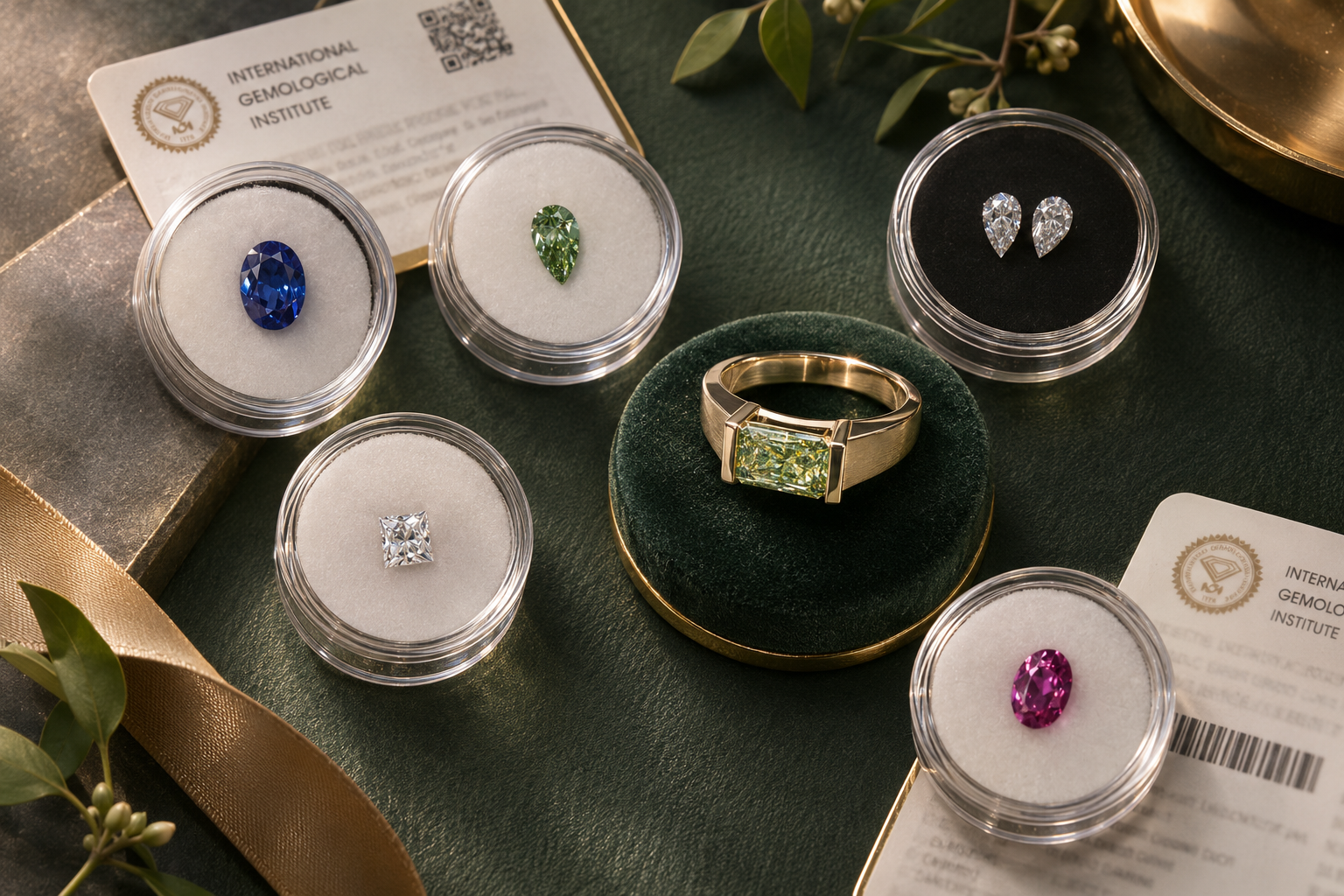
Then something changed. Anthony went deep, researching color grades, clarity, pricing, lab-grown versus natural, not just diamonds, but sapphires, rubies, emeralds. And because he shares what he learns, I learned too.
Suddenly, I was noticing cuts, comparing colors, and falling hard for green diamonds, something I didn’t even know existed. Natural green diamonds are among the rarest gems on earth. In 2016, the Aurora Green, a natural vivid green diamond just over five carats, sold at auction for $16.8 million, more than $3.3 million per carat. Lab-grown is the only reason a green diamond was ever within my reach.
I had a green diamond wedding ring made, about 1.7 carats, and I’ve got another two-carat, white diamond waiting its turn.
Somewhere along the way, I fell for yellow gold too. After wearing only silver and white gold for decades, that green stone in yellow gold just clicked.
Lab-grown or natural?
I know some people hear “lab-grown” and assume it means lesser. It doesn’t. A lab-grown diamond isn’t an imitation like cubic zirconia. It’s real diamond: the same carbon, the same crystal structure, the same hardness, the same fire. Not something that highly publicized, in 2018, the Federal Trade Commission removed the word “natural” from its definition of a diamond for exactly that reason, and the Gemological Institute of America (Gia) and the International Gemological Institute (IGI) grades lab-grown stones on the same color and clarity scales it uses for mined ones. These graded diamonds even have a laser-engraved serial number that you can only see under a loop. Natural and lab-grown gens are so indistinguishable that without a lab’s equipment, you can’t tell them apart.
The difference is where they come from. A lab-grown diamond starts in a controlled facility, not a mine, so no land is dug up to find it, and its origin is easy to trace. That means I don’t have to wonder about the labor or the conflict that can sit behind a mined stone. The environmental picture depends on how a lab is powered, but growers running on renewable energy can make a diamond with a much smaller footprint than mining one. Whether you buy online or in a retail store, it’s worth asking about when you buy.
To be fair, natural diamonds hold their resale value better, and some people love knowing their stone formed deep in the earth over a billion years. That’s a valid choice. But if what you want is beauty you can wear and feel good about, lab-grown gives you the real thing, often more of it, for a fraction of the price.
The bigger picture
There’s a larger part to this experience. For so long, extraordinary gemstones felt like royal territory, not for people who looked like me or lived like me. But I don’t think we need permission or representation to be curious.
We shouldn’t limit our interests because of the past or because we don’t see ourselves represented.
And in hard times, we need to be surrounded by the things that make us feel good. Creating a piece of jewelry, choosing the stone, the setting, the metal, has become a small personal reward, a reminder that life isn’t only goals and grinding.
Life gets challenging. If you stay open, you may find little sparkles along the way, even in the dark. Sometimes they’re diamonds. Sometimes it’s just letting yourself be surprised by joy.